Updated May 16, 2026
Stereoselective route identification
Medicinal chemist: identify routes that produce the desired enantiomer or diastereomer.
For chiral drug candidates where stereochemistry drives activity, the platform respects explicit stereochemistry in your SMILES and surfaces literature procedures that address stereocontrol. This tutorial walks through identifying routes that produce the desired enantiomer or diastereomer.
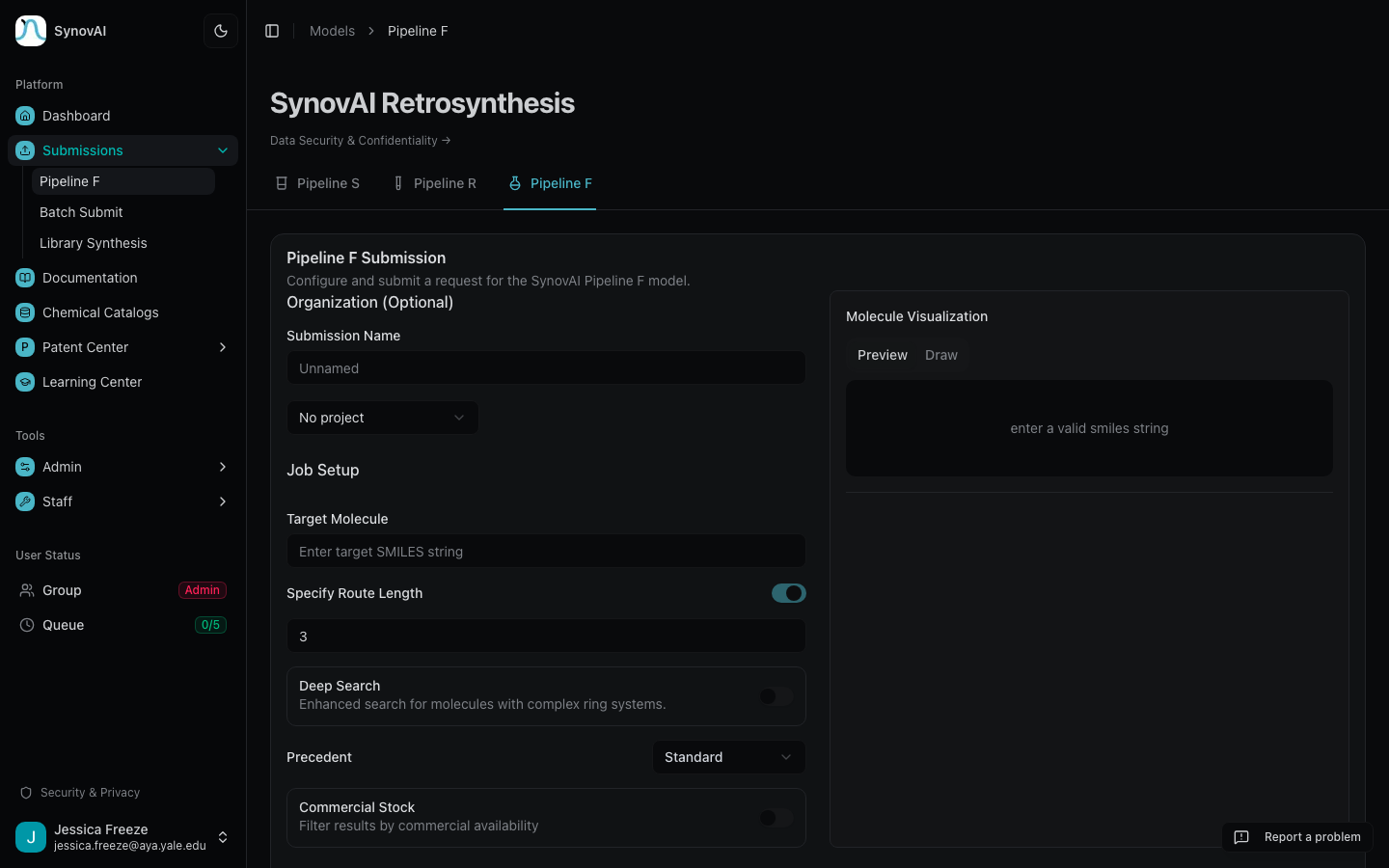
Steps
- Open the retrosynthesis form.
- Switch the Molecule Visualization panel to the Draw tab to bring up Ketcher.
- Draw your target with explicit stereochemistry: wedge bonds for
tetrahedral centers, double-bond geometry for E/Z. Confirm the
SMILES output preserves
@/@@and//\markers. - Submit at a moderate route length (3-5). Stereocontrol routes tend to be longer than racemic equivalents; keep length at the top of plausible.
- On the result, click into each step. The reference entries include literature procedures that often note the stereochemistry outcome of that transformation type.
- Look for steps where the published literature explicitly addresses stereoselectivity (chiral catalysts, chiral auxiliaries, enantioselective methods). Favorite routes whose key stereocenter is set by such a literature-supported step.
- Use Route Builder to mix-and-match steps if a single result doesn't have stereoselective methods at every center.
Caveats
The model preserves stereochemistry as expressed in your input but won't always rank stereoselective methods above racemic ones. The human-in-the-loop step (you reviewing the references) is what closes the gap.