What does precedent actually mean?
How the precedent slider steers the model between conservative and creative disconnections.
The precedent slider controls how closely a proposed route has to resemble reactions the model has seen before. It's the single most consequential parameter in the search, and it's the one most worth understanding deeply.
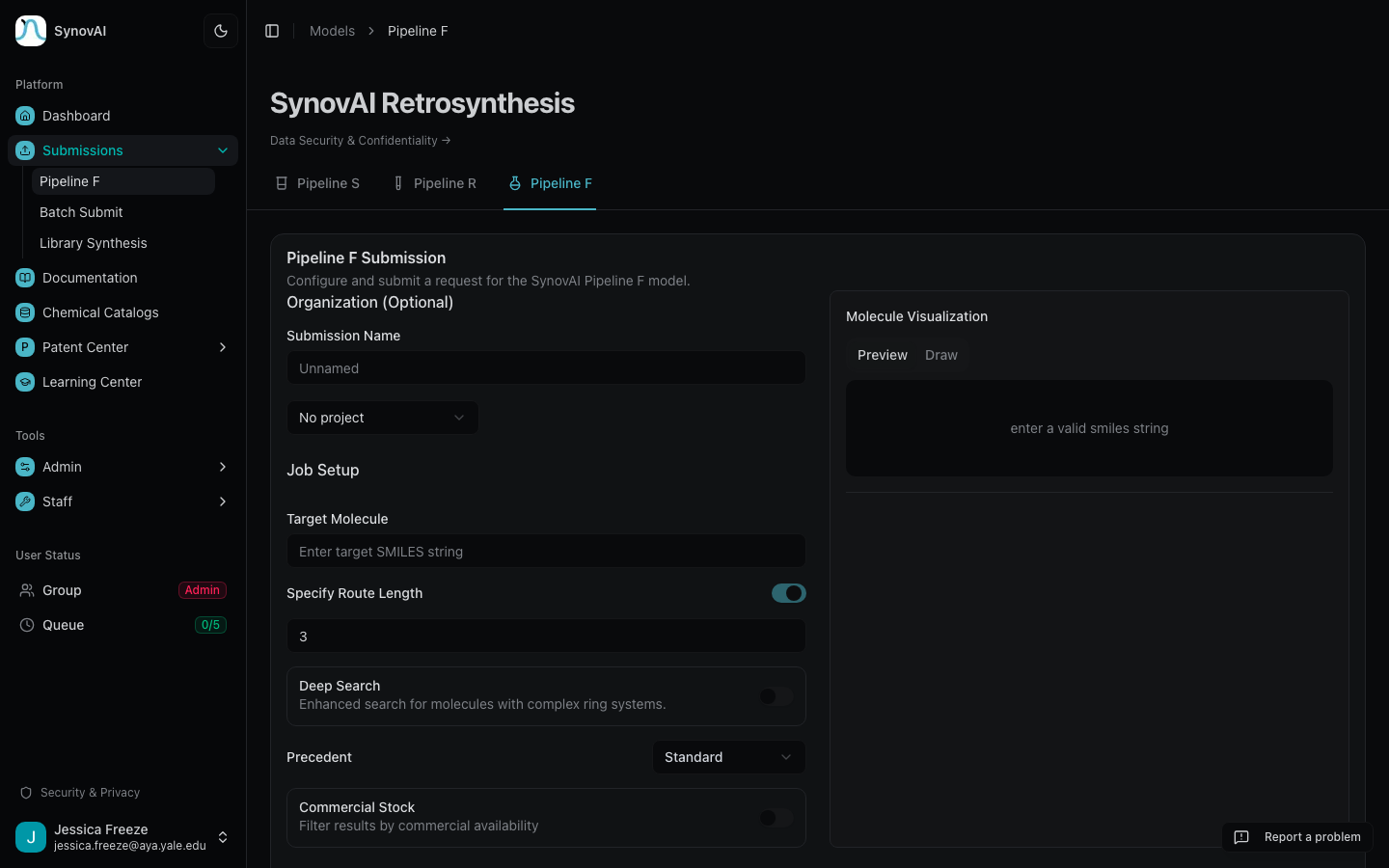
The three settings
| Setting | What it does |
|---|---|
| Well-Precedented | Only propose transformations that closely match published examples. Every step has strong precedent. |
| Standard | Default. Allow moderate extrapolation from precedent. Most routes still have literature support; some are interpolations. |
| Novel | Propose creative disconnections, including ones the model hasn't directly seen. Higher diversity, lower trust. |
What's happening under the hood
When the model proposes a reaction step, it also computes a similarity score between that step and the examples in its training data. The precedent slider sets a threshold:
- Well-Precedented — only keep steps with similarity above a high threshold. The model effectively pattern-matches to published chemistry.
- Novel — lower the threshold so the model can propose steps that are only loosely similar to precedent, or that combine known transformations in new ways.
This is why low-precedent routes feel more creative but require more chemist judgment: the model is extrapolating, and extrapolations are where it's most likely to be wrong.
When to use each
- Medicinal chemistry scouting → Standard. Balance of novelty and plausibility.
- Process chemistry route selection → Well-Precedented. You want routes that will work on the first try at 100× scale.
- Natural product / academic work → Novel. Worth seeing unconventional disconnections even if most won't pan out.
- Target not returning any routes → try Novel before giving up. Sometimes the scaffold is unusual enough that standard precedent doesn't cover it.
Relationship to the feasibility score
Precedent and the feasibility score measure different things. Precedent filters which routes the model is willing to propose; feasibility evaluates each proposed route across five independent dimensions. A "Novel" route can still earn a high feasibility score if the steps are individually reasonable — and a "Well-Precedented" route can score low if it's 10 steps long with chromatography on every one.
Use precedent to shape the population of routes the model generates. Use scoring profiles to rank that population by what matters to you.