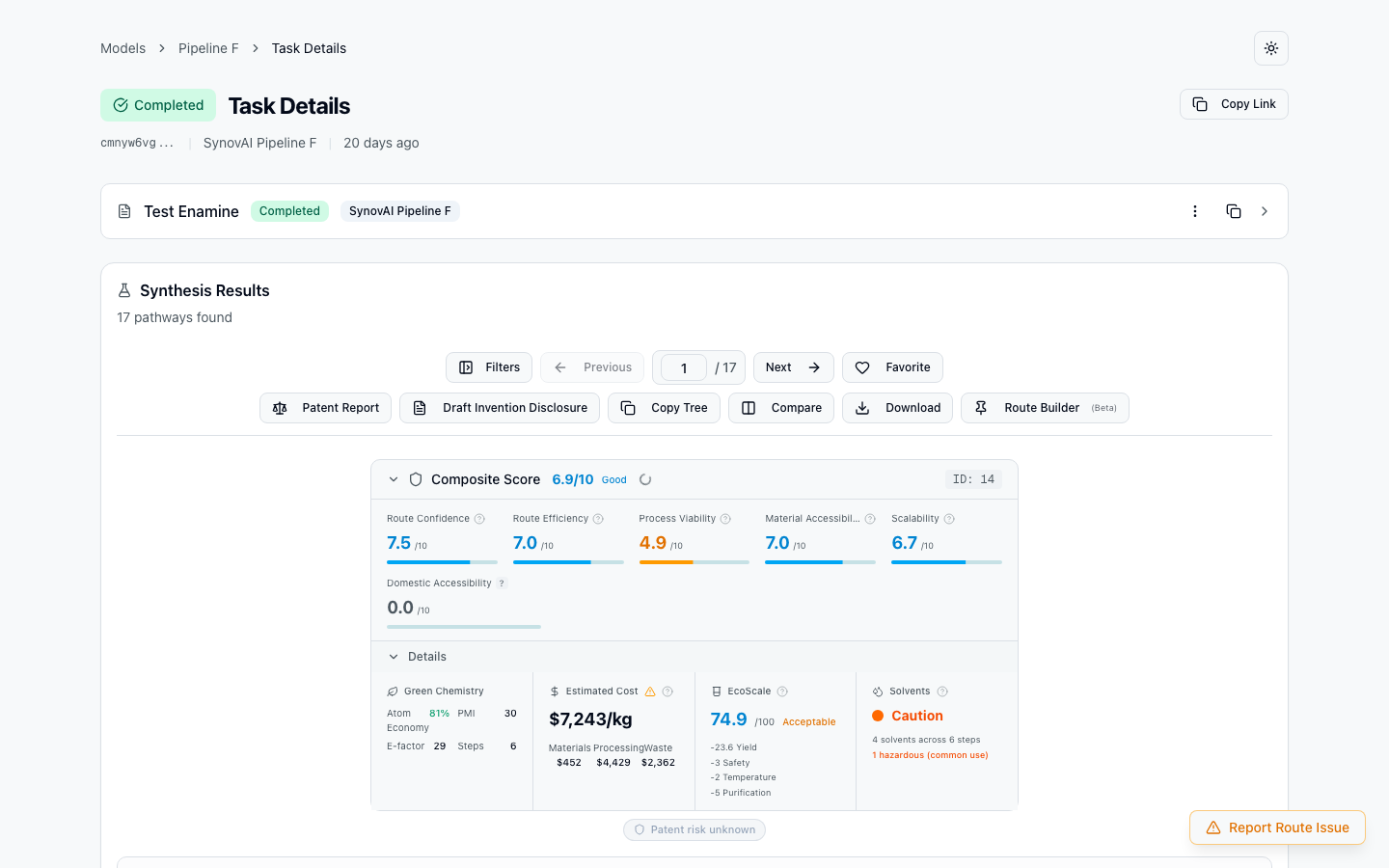
Feasibility score
The composite 0-10 score and its five dimensions.
Every route shows a Feasibility Score (0–10) that combines five independently computed dimensions into a single composite. The score is designed so that different chemists — discovery, process, procurement — can each see the dimension that matters to them while still having one number to sort and compare by.
The five dimensions
Route Confidence (0–10)
How well-precedented each reaction step is, based on the model's training data. A score of 9+ means every step has strong precedent in published chemistry. A score below 5 means one or more steps rely on novel or weakly supported transformations. This is the model's own assessment of chemical plausibility — it reflects how closely each proposed reaction matches reactions the model has seen before.
Scalability (0–10)
How well each reaction step is expected to scale up for manufacturing. High scores indicate reactions that typically work at larger scales without significant yield loss or safety concerns. Low scores flag reactions that may work in milligram quantities but are known to be problematic at kilogram or larger scale — for example, reactions requiring cryogenic conditions, chromatographic purification, or exotic catalysts.
Material Accessibility (0–10)
What fraction of the starting materials (leaf nodes in the route tree) are commercially available. The score accounts for both availability and vendor diversity — a starting material available from 50+ vendors scores higher than one available from a single supplier.
Route Efficiency (0–10)
A structural assessment of the route based on step count, longest linear sequence (LLS), and branching. Shorter routes score higher. Convergent routes (with parallel branches that merge) score higher than linear routes of the same length, because parallel branches can be executed simultaneously, reducing total elapsed time. Complex starting materials (many heavy atoms in leaf nodes) reduce the score. This dimension is purely structural — it does not depend on the model's confidence or any external data.
Process Viability (0–10)
A composite of four sub-scores assessing how practical the route is from a process chemistry perspective:
- EcoScale (Van Aken, 0–100 → mapped to 0–10) penalizes yield loss, expensive reagents, harsh conditions, and chromatography.
- Solvent sustainability (ACS GCI guide) rates the solvents as recommended, problematic, or hazardous.
- Hazard count flags carcinogens, reproductive toxins, explosive reagents, and other safety concerns.
- E-factor (Sheldon) measures kg of waste per kg of product.
A low Process Viability score means the route may work chemically but has practical concerns around safety, sustainability, or waste generation.
The composite score
The overall Feasibility Score is a weighted average of all five dimensions.
| Dimension | Default weight |
|---|---|
| Route Confidence | 25% |
| Material Accessibility | 20% |
| Scalability | 15% |
| Route Efficiency | 15% |
| Process Viability | 15% |
Dimensions with unknown data (e.g., Material Accessibility before vendor data loads) are excluded and their weight is redistributed proportionally.
| Rating | Score |
|---|---|
| Excellent | 8+ |
| Good | 6–8 |
| Moderate | 4–6 |
| Poor | <4 |
You can sort all routes by feasibility score using the Highest feasibility sort option in the filter sidebar.