Process Chemist
Scale-up feasibility, COGS, green chemistry, and supply-chain options.
Recommended reading order
5 pages- 1FeaturesFeasibility scoreThe composite 0-10 score and its five dimensions.
- 2FeaturesGreen chemistry metricsAtom economy, PMI, E-factor, COGS, EcoScale, solvent sustainability.
- 3FeaturesHazard flagsAutomatic warnings for carcinogens, toxins, and explosive reagents.
- 4FeaturesReagent swap suggestionsGreener and safer alternatives for reagents and solvents.
- 5FeaturesCommercial stock filteringFilter routes by commercially available starting materials.
Why this role uses SynovAI
Evaluate and plan synthetic routes with manufacturing constraints in mind.
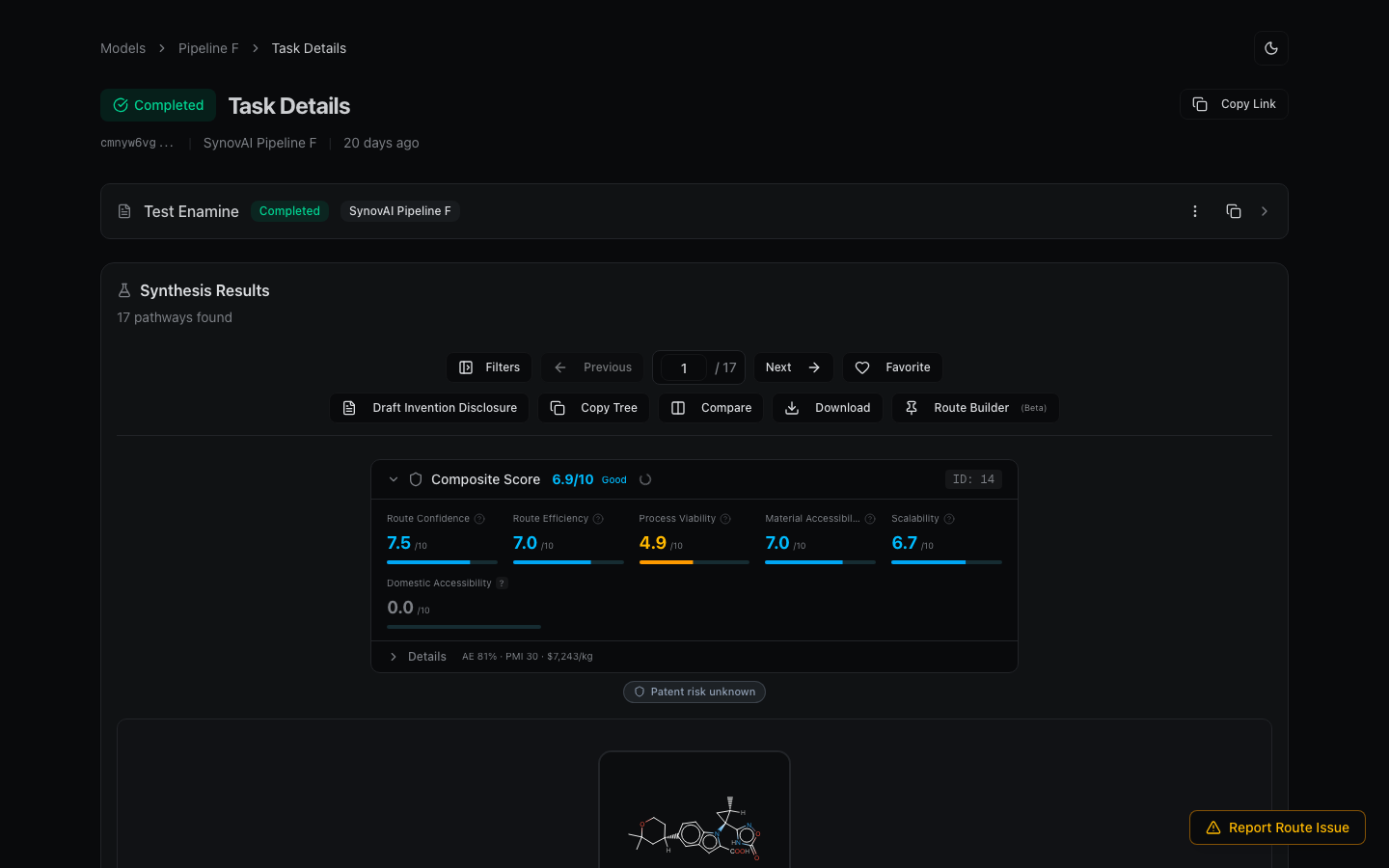
Route evaluation for scale-up feasibility
When transitioning a medicinal chemistry route to process scale, use the scalability index to identify steps that may be problematic at scale. Review the reference procedures for reaction conditions — routes using mild temperatures, common solvents, and avoiding chromatographic purification are preferred. Compare alternative routes to find the most manufacturing-friendly path.
Cost-optimized starting material selection
Enable commercial stock filtering to restrict routes to commercially available starting materials. Compare routes by step count and reagent cost — fewer steps with inexpensive, bulk-available reagents translate directly to lower cost of goods. Use vendor badges to verify that starting materials and intermediates are commercially available before committing to a route.
Alternative route discovery for supply chain resilience
When a key intermediate or reagent faces supply constraints, submit your target with different starting material specifications to find alternative routes that bypass the bottleneck. The "Novel" precedent setting can surface unconventional approaches that use more readily available feedstocks while still reaching your target efficiently.
Green chemistry and COGS comparison
Use the Green Chemistry scoring profile to rank routes by atom economy and PMI. Every route shows estimated COGS ($/kg) broken down into materials, processing, and waste — compare manufacturing economics across hundreds of routes in seconds. Reagent swap suggestions flag opportunities to replace hazardous or wasteful reagents with greener alternatives, while hazard flags automatically identify carcinogens, reproductive toxins, and explosive reagents before your team goes to the bench.