Green chemistry metrics
Atom economy, PMI, E-factor, COGS, EcoScale, solvent sustainability.
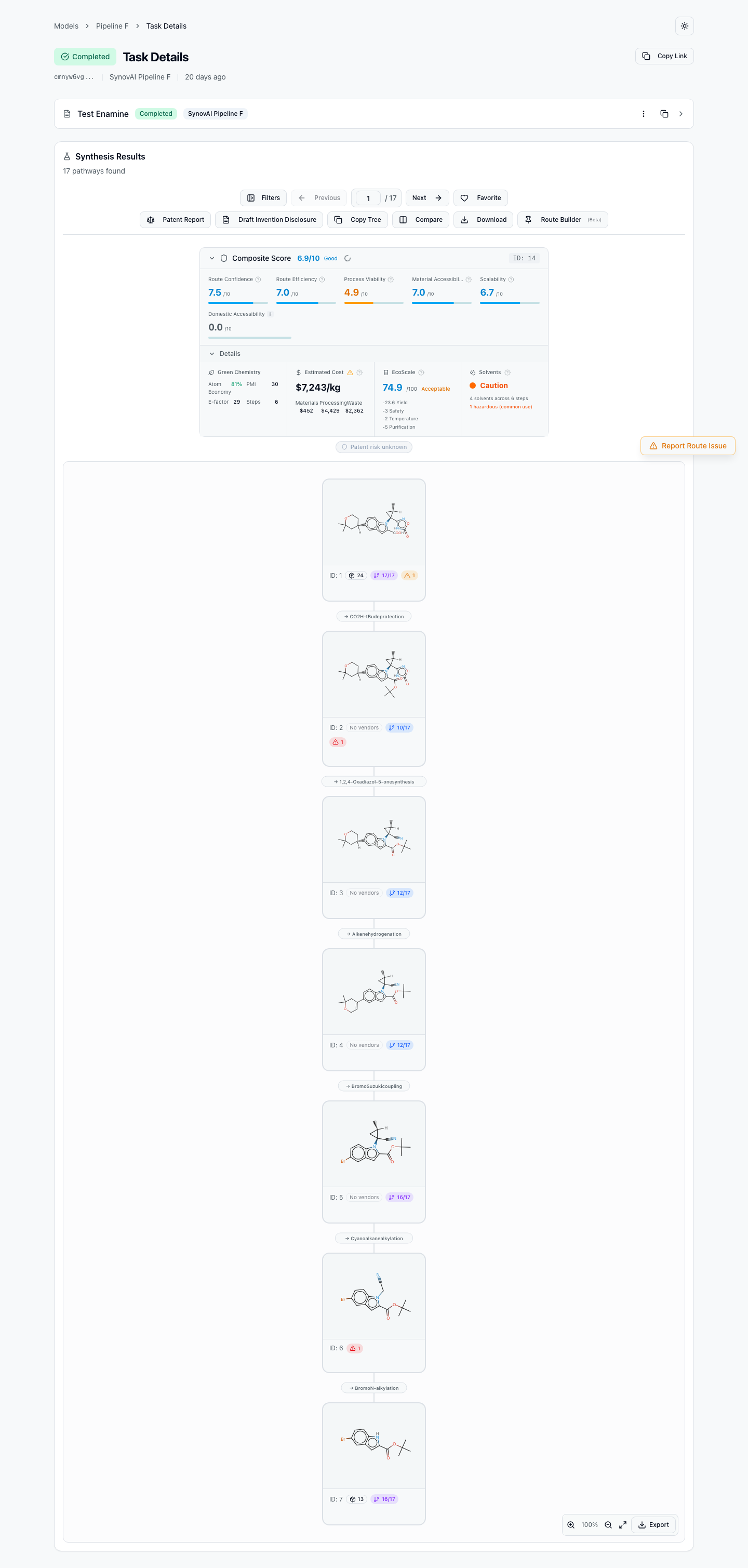
The Details panel (click to expand below the feasibility dimensions) shows the underlying green chemistry, cost, and safety numbers that feed into the feasibility score.
Atom Economy (%)
Percentage of reactant atoms that end up in the desired product. Calculated per step and compounded across the entire route. 100% means no waste atoms (ideal). In practice, most multi-step pharmaceutical routes achieve 10–50% overall atom economy. Higher is greener. Based on heavy atom count as a proxy for molecular weight.
Process Mass Intensity (PMI)
Kilograms of total input (reactants + solvents + reagents) per kilogram of product. Lower is greener. Includes an estimate for solvent and workup waste.
| Rating | PMI |
|---|---|
| Excellent | <20 |
| Good | 20–50 |
| Moderate | 50–100 |
| Poor | >100 |
Benchmarks are from the ACS GCI Pharmaceutical Roundtable. A PMI of 50 means 50 kg of material goes in for every 1 kg of product out.
E-factor (Sheldon)
Kilograms of waste generated per kilogram of product. E-factor = PMI − 1. Introduced by Roger Sheldon in 1992, it is the most widely cited green chemistry metric. Pharmaceutical industry typical range: 25–100+.
| Rating | E-factor |
|---|---|
| Excellent | <10 |
| Good | 10–25 |
| Moderate | 25–50 |
| Poor | >50 |
Convergent PMI
For branched (convergent) routes, PMI is also calculated using the Longest Linear Sequence instead of total steps. Convergent routes are more efficient because parallel branches don't compound waste the same way sequential steps do. Only shown when the route has branch points. The convergence advantage percentage shows how much better the convergent PMI is vs. linear.
Estimated COGS ($/kg)
Rough cost-of-goods estimate for manufacturing 1 kg of the target compound via this route. Broken down into:
- Materials — starting materials + reagents, adjusted for cumulative yield loss.
- Processing — labor, equipment, utilities per step.
- Waste — solvent procurement + hazardous waste disposal.
Uses pharmaceutical industry averages: starting materials ~$50/kg, reagents ~$200/kg, processing ~$150/kg/step, waste disposal ~$3/kg. For planning-level comparison between routes, not precise costing.
EcoScale (Van Aken, 0–100)
Starts at 100 and subtracts penalty points across five categories:
- Yield —
(100 - yield%) / 2per step - Reagent cost — 5 points for precious-metal catalysts
- Safety — 3–5 points for hazardous reagents / solvents
- Temperature — 2–5 points for heating or cryogenic conditions
- Purification — 5 points for chromatography (assumed at discovery scale)
Penalties are averaged per step so multi-step routes remain comparable.
| Rating | EcoScale |
|---|---|
| Excellent | 75+ |
| Acceptable | 50–75 |
| Inadequate | <50 |
Solvent sustainability
Rates the solvents used across all steps according to the ACS GCI Pharmaceutical Roundtable Solvent Selection Guide and CHEM21 methodology. Each solvent is classified as Recommended, Problematic, Hazardous, or Highly Hazardous, with individual safety, health, and environment scores (1–10 each). Overall route rating:
- Green — no hazardous solvents
- Amber — problematic solvents only
- Red — any hazardous or highly hazardous solvents
Covers 48 common laboratory solvents.
What to read next
- Feasibility score — how these metrics feed into the composite score.
- Reagent swap suggestions — greener alternatives flagged automatically.