Updated May 16, 2026
Evaluating route environmental footprint
Environmental chemist: compare routes on PMI, atom economy, E-factor, and EcoScale before commitment.
A route's environmental footprint compounds over kilograms produced. Choosing the cleanest route at planning time avoids the worst emissions, solvent loads, and energy demands at scale. This tutorial walks through evaluating environmental impact before any wet-lab commitment.
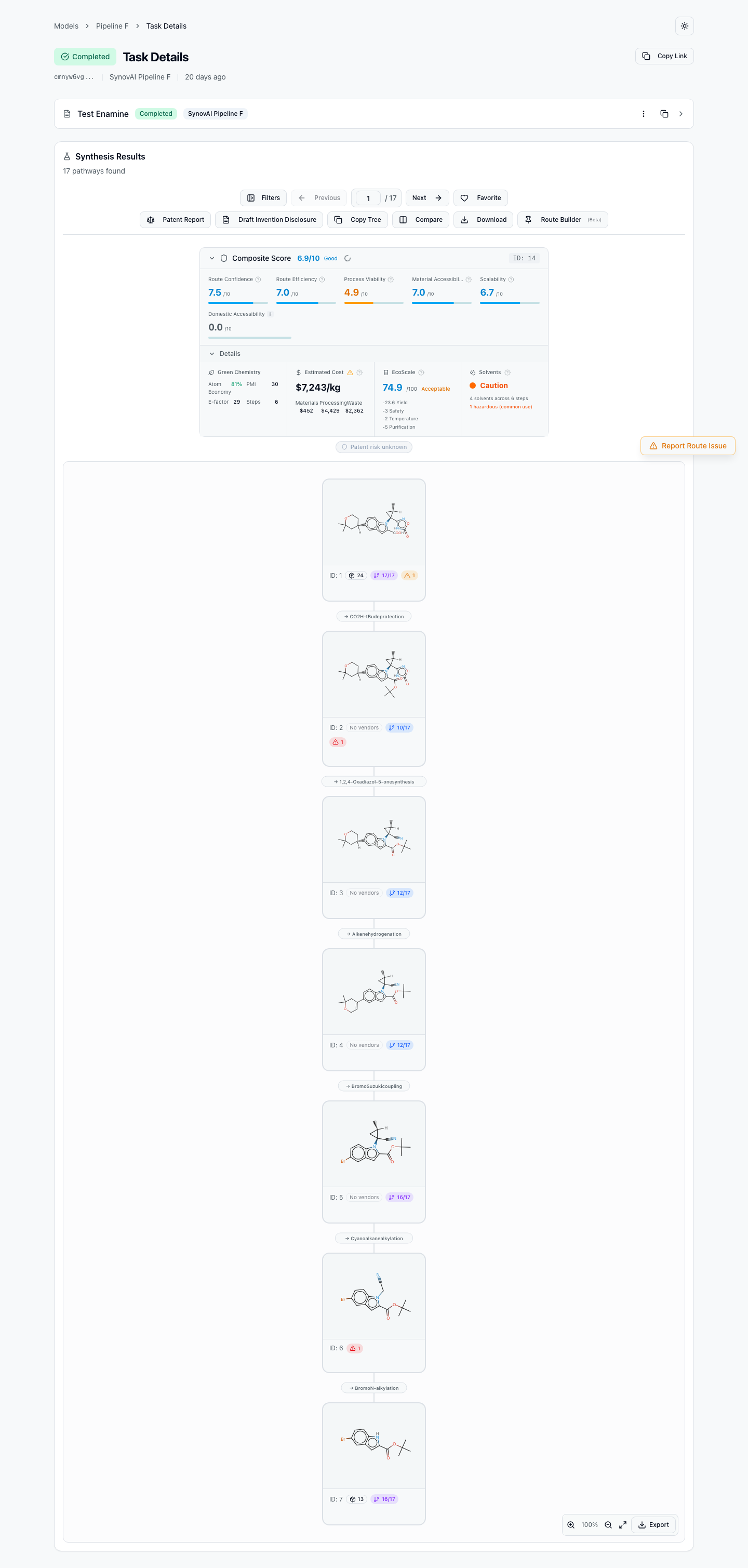
Steps
- Open a finished retrosynthesis result.
- Open the green chemistry metrics panel for each candidate route. The panel reports atom economy, PMI (process mass intensity), E-factor, EcoScale, and solvent sustainability, computed per route.
- Rank routes by these metrics. A high atom economy paired with a low PMI usually means a route that wastes little material; a high EcoScale (well-precedented, mild conditions) typically tracks with lower energy demand.
- For each top route, open the reference entries and skim the reaction conditions: ambient or near-ambient temperatures, water or short-chain alcohols as solvents, and aqueous workups all read as low-impact.
- Flag steps that use chlorinated solvents, dipolar aprotic solvents (DMF, DMSO, NMP), or temperatures above 100°C. These are the dominant footprint contributors and the first places the reagent-swap suggestions usually fire.
- Favorite the route with the cleanest aggregate footprint.
Output
A route selected against environmental metrics, suitable for including in a green-chemistry justification or in a sustainability report tied to a development candidate.